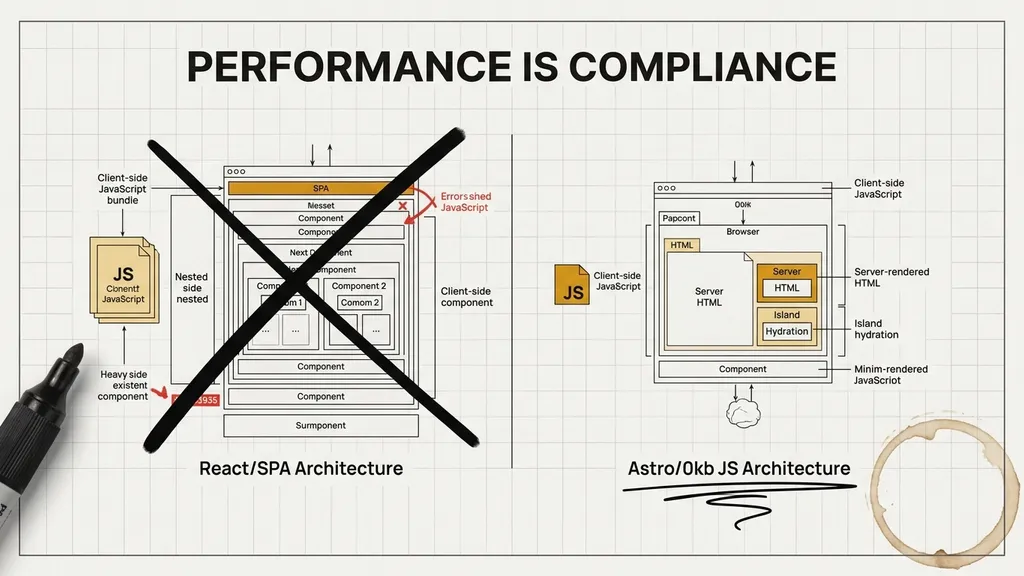
In 2026, as we prepare for the full enforcement of strict data protection frameworks—like Europe’s GDPR and Paraguay’s upcoming Law 7593/2025 (fully enforced by 2027)—the efficiency of your software is no longer a vanity metric; it is a matter of operational sovereignty and legal compliance. If your logistics platform or e-commerce site dispatches megabytes of useless JavaScript to rural areas in Latin America, you are hiding attack surfaces and monitoring risks that expose you to massive fines from regulatory bodies like the ANPDP.
Why field latency halts agro-industrial logistics#
When evaluating the technical infrastructure of private ports and agro-exporters, the pattern repeats itself. Hundreds of trucks wait during peak harvest while the freight loading system—built on a heavy framework no one asked for—takes 15 seconds to respond. The 4G signal is unstable, and the driver’s smartphone freezes trying to parse 5MB of redundant JavaScript.
The truck doesn’t move. The line grows. Efficiency plummets.
This isn’t about user patience. It’s a hard technical blockade. Your software cannot rely on a fiber-optic connection in the capital to function in a rural silo. Performance is a design constraint, not an afterthought optimization.
Privacy by Design: The Legal Risk of Garbage Code#
Excessive JavaScript doesn’t just slow down your site; it drastically increases the attack and monitoring surface where unaudited third-party integrations can hide, often leaking data without oversight.
In almost every corporate audit I conduct, I find the same thing: forgotten marketing pixels, analytics from agencies that no longer work with the company, and widgets that read user IPs and behavior without oversight. Industry benchmarks show that while third-party scripts might only represent 15% of the total page weight, they can monopolize the browser’s CPU execution time, often hiding data leaks behind performance bottlenecks. Under modern privacy laws, this is a massive legal liability.
These laws demand Privacy by Design. If you don’t know what those 3MB of scripts are loading in your client’s browser, you are operating blind. Auditing the Network Payload is the only practical way to verify what data is actually leaving your system. Without that visibility, compliance is purely theoretical. If you cannot audit the origin of every bit you send, you do not have sovereignty over your data.
The AI Mirage and “Vibe Coding”#
Generating code with Claude or Copilot is easy; understanding its systemic consequences is the real job. The trend of “Vibe Coding”—accepting AI-generated code without reviewing new dependencies, bundle size impact, or data flow—is creating systems that are functionally correct but architecturally obese.
An AI agent can deliver a functional portal in 48 hours, but it will hand it to you coupled and full of redundant dependencies that no one will know how to maintain in two years.
Pros
- Aggressive Time-to-Market.
- Almost instant prototyping.
Cons
- Technical debt multiplied.
- Payloads that destroy INP and mobile UX.
- 'Ghost' dependencies that no one audited.
AI writes fast, but your infrastructure pays the bill slowly.
A Senior Architect has never been more necessary to filter the noise of generated code.
The Stack Autopsy#
At campa.dev, we don’t audit to get a 100 on Lighthouse; that’s just the baseline. We audit to make your business resilient:
Real Stress Metrics
Payload Cleansing
Migration Path
Most companies don’t have a performance problem. They have a visibility problem.
They don’t know what’s running on their frontend. They don’t know what data is leaving. They don’t know what they are breaking.
A sovereign, fast, and legal system is your right to operate without friction, but you cannot fix what you haven’t measured.
Do you know what your code is doing right now?
If your business handles critical data or field logistics, you can’t afford to wait until 2027. Book an Express Audit: in 7 days you will see exactly what data is leaving your system, which AI-generated dependencies you don’t control, and where you are legally exposed today. stem is your right to operate without friction, but you cannot fix what you haven’t measured.
Do you know what your code is doing right now?
If your business handles critical data or field logistics, you can’t afford to wait until 2027. Book an Express Audit: in 7 days you will see exactly what data is leaving your system, which AI-generated dependencies you don’t control, and where you are legally exposed today.