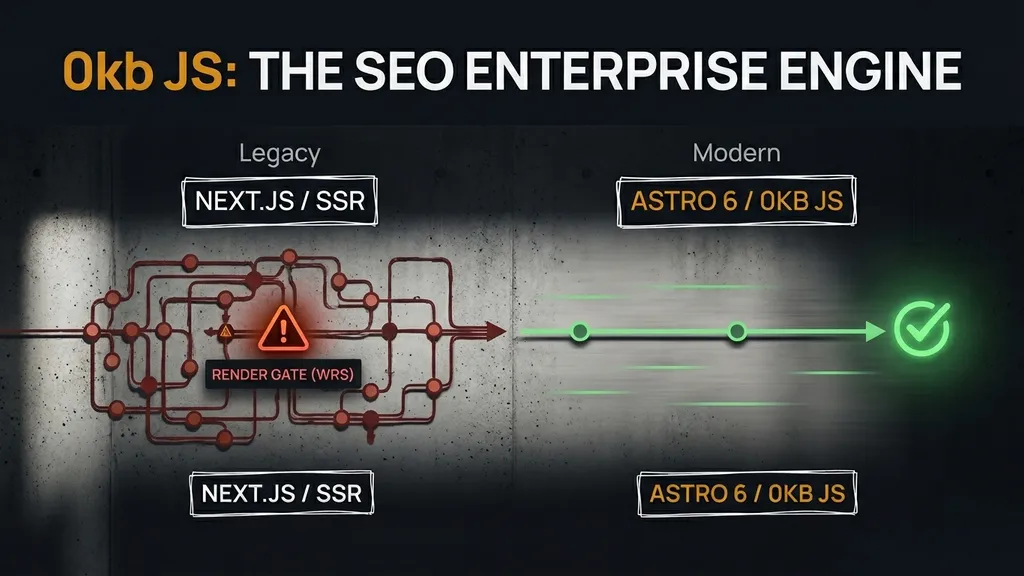
Crawl Budget is the scarcest resource in enterprise SEO. Google defines it as “the number of URLs Googlebot can and wants to crawl” — and that number has a strict efficiency ceiling. Sites with 100k+ URLs using JS-heavy frameworks (Next.js, Nuxt) waste critical fetch capacity on the Web Rendering Service (WRS), Google’s infrastructure that executes JavaScript but introduces processing queues that can last for days or weeks. Astro 6 solves this by eliminating rendering friction by design: pure static HTML, 0kb JS runtime by default, and an Islands Architecture that guarantees render fidelity. This immediate visibility isn’t just for traditional search engines; it’s the foundation for being cited by AI agents that often bypass dynamic content.
How much crawl budget is your site wasting on JavaScript?#
Google doesn’t publish an exact daily URL limit, but it does confirm that crawl budget is finite and gets throttled when servers respond slowly or throw errors (Google Search Central).
When your site requires JavaScript to render content, Googlebot makes two passes: first the basic HTTP crawl, then the WRS to execute the JS. That second pass isn’t instant — URLs enter an asynchronous queue that can take hours or days after the initial crawl.
LinkGraph (January 2026) confirms that JavaScript rendering is a separate “crawl budget lever” from the crawl budget itself — what they call render budget. A site can be crawled but never rendered, creating “zombie pages”: technically discovered but with incomplete content in Google’s index.
Go Fish Digital (February 2026) goes further: “When bots waste finite fetch capacity on low-value filters, duplicate parameter states, or discontinued products instead of your newest high-margin arrivals, you don’t just lose rankings, you lose time.”
The economics of 0kb JS#
Astro 6 ships zero JavaScript to the client by default. The HTML Googlebot receives is the HTML that gets indexed — no second pass, no rendering queue, no zombie pages.
Astro 6 doesn’t forbid dynamism; it atomizes it. While an enterprise site with 500k URLs on Next.js often forces a full page render on the server (monolithic SSR) or on the client (CSR), Astro uses Server Islands (server:defer) to serve critical content as instant static HTML and render dynamic components on-demand and in parallel.
This allows the site to be deployed on a global CDN without relying on heavy server infrastructure for the page core. The result for the user is the same, but for Googlebot, the “rendering gate” remains open and frictionless, as the main content is already in the first byte.
Astro’s Islands architecture hydrates only the interactive components that need JS. The rest of the content — which is 80-90% of any content site — arrives as pure static HTML.
Search Engine Land (March 2026) details the “five infrastructure gates” between discovery and index — and the rendering gate is the most problematic: “Content behind client-side rendering that the bot never executes isn’t degraded, it’s gone.”
Jason Barnard describes the pipeline as 5 sequential gates: Discovery → Selection → Crawling → Rendering → Indexing. Each gate is a sequential dependency — if you fail at rendering, everything downstream inherits that degradation.
With Astro 6, the rendering gate becomes practically unnecessary. The content is already in the HTML Googlebot downloads during the Crawling phase. No WRS queue. No waiting. The page goes straight to indexing.
Barnard confirms something crucial: “The bot’s willingness to invest in rendering your page isn’t uniform.” Familiar patterns (WordPress, known platforms) have less friction. Bespoke code — even if perfect — has more friction because the bot has no pattern library to validate against. Astro generates predictable, semantic HTML, reducing that friction.
| Aspect | Next.js (SSR/CSR) | Astro 6 (SSG/Islands) |
|---|---|---|
| Infrastructure gates | Discovery → Selection → Crawl → Render → Index (5) | Discovery → Selection → Crawl → Index (4) |
| JS Runtime shipped | 150-400kb per page (typical) | 0kb (hydrated islands only) |
| Render fidelity | Variable — depends on bot executing JS | 100% — content is in the HTML |
| Infrastructure | SSR servers + CDN + Node.js runtime | Static CDN (no server) |
| AI bot visibility | Partial — most don't execute JS | Complete — pure HTML |
The ROI of technical minimalism#
It’s not just about speed. It’s about economics and visibility.
An enterprise site with 500k URLs on Next.js needs SSR servers to pre-render content, a CDN for caching, and accepts that Googlebot will take longer to index the full catalog because every page requires a second rendering pass. With Astro 6, that same site deploys as static files on a CDN — no server, no Node.js, no rendering queue.
But there’s an angle most people ignore: AI bots don’t execute JavaScript. Search Engine Land confirms that “Google and Bing render JavaScript. Most AI agent bots don’t. They fetch the initial HTML and work with that.” Perplexity, smaller AI agents, and training crawlers — they all work with the initial HTML. If your content is behind JS, those bots can’t see it.
With Astro 6, content is in the initial HTML — visible to Googlebot, Bingbot, and all AI bots.
When NOT to use Astro 6 in enterprise#
Not everything should go to Astro. The key is distinguishing between content sites and web applications.
Astro 6 vs Next.js for Enterprise
Astro 6 (Content Sites)
- E-commerce with large catalogs (100k+ products)
- Directories and marketplaces with static content
- Technical documentation and content portals
- Landing pages and corporate sites at scale
Next.js (Web Applications)
- Dashboards with real-time data
- Apps with complex per-route authentication
- Collaborative tools (editors, whiteboards)
- SaaS platforms with client-side business logic
Ockham’s Razor applied to enterprise SEO#
The simplest solution is usually the right one. If your problem is that Googlebot isn’t indexing all your URLs, the answer isn’t more servers, more SSR, or more infra budget. The answer is less JavaScript.
Astro 6 isn’t a framework for building applications — it’s an architecture for publishing content. And in enterprise SEO, content is what Googlebot needs to find, render, and index. The less you force it to work, the more URLs it’ll process.
And in 2026, with AI bots gaining weight in digital visibility, static HTML isn’t just a performance optimization — it’s a multi-bot visibility strategy.
If you want to go deeper on how Astro 6 solves other enterprise problems, check out the dev/prod parity guide or how GEO is changing SEO for AI.