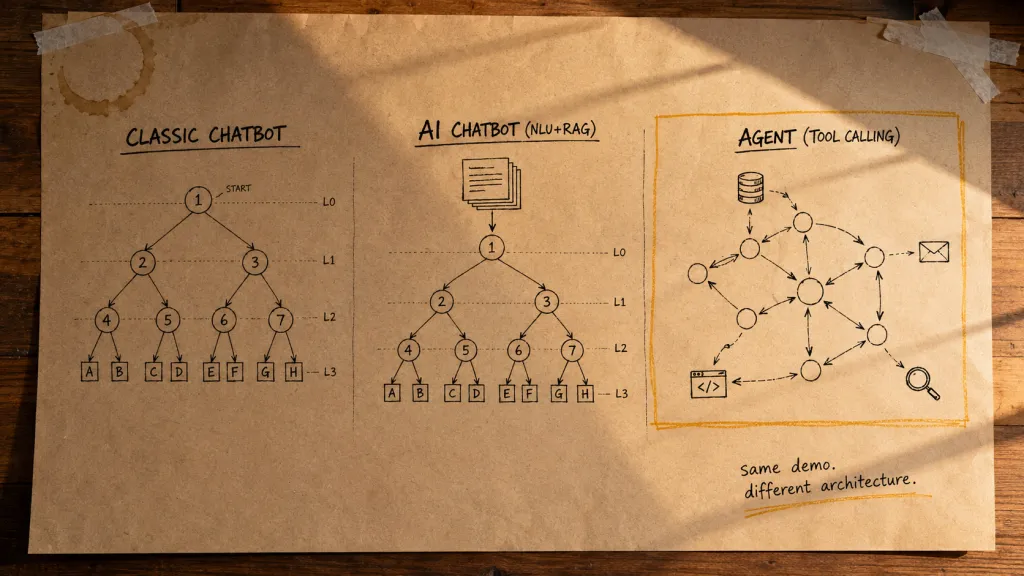
The difference between a chatbot and an AI agent that actually matters is not technical: it’s operational. Most solutions sold today as “agents” in Paraguay are chatbots with a language model on top. More expensive. Just as rigid. Understanding that distinction defines what your business can automate today and what still needs a human.
The difference in one sentence#
A chatbot follows a tree. You program every possible branch: if the user writes X, respond Y; if they write Z, show menu W. Anything outside the tree produces a “didn’t understand” or sends the user back to the beginning of the flow.
An agent receives the objective and decides how to resolve it. If a producer in Itapúa asks for the soybean price for delivery in 15 days, the agent doesn’t look in a hardcoded table: it calls the pricing system, verifies available quota, confirms logistics conditions, and builds the response on real-time data.
The difference isn’t that the agent is smarter. It’s that the agent has tools.
That sentence contains everything. A chatbot has pre-built responses; an agent has actions it can execute against real systems. When your business requires answers that depend on real-time data, pre-built responses fall short no matter how much natural language you layer on top. The problem isn’t linguistic. It’s architectural.
That’s why the question “which is better?” is the wrong question. They’re different tools for different use cases. The confusion comes from selling one as if it were the other.
| Classic Chatbot | AI Chatbot (NLU+RAG) | RecommendedAgent (tool calling) | |
|---|---|---|---|
| When it doesn't have the answer | Returns to menu or throws an intent error | Responds with what's in the RAG; can hallucinate if no context exists | Queries your systems in real time before responding |
| Data access | Only what's hardcoded in the flow | Only indexed documents, no real-time data | ERP, prices, quotas, and any configured API |
| When the business changes | Have to reprogram the tree | Have to update the RAG documents | Update the data at the source; the agent reads it |
| Maintenance cost | High: every new case is code | Medium: keep documents up to date | Low: the system follows the data, not the other way around |
| Multi-step objectives | Only if that sequence was programmed | Only if the full process is documented | The orchestrator resolves it in real time |
Why almost everything you were sold is a chatbot#
Over the past year I’ve been in conversations with companies in the region that believed they had agents in production. Almost all of them had Dialogflow, ManyChat, or an n8n flow with GPT paraphrasing the responses at the end. The live demo closed meetings. The price was two or three times higher than a standard chatbot solution. The operational result, for questions outside the script, was the same: the system failed.
The trick is subtle and worth understanding before you buy. When a chatbot uses an LLM to generate the response text, it feels more natural and less mechanical than one that returns hardcoded strings. But if the LLM is working on top of a base of preset intents and responses, the underlying architecture is still a decision tree. The language changed. The architecture didn’t.
There are three concrete signals that what you have is a chatbot with NLUNatural Language Understanding: the technology that lets a system understand what the user wrote without requiring exact keyword matches. on top, not an agent:
Wrong answers follow a recognizable pattern. It’s always the same questions that fail — the ones nobody anticipated when they programmed the flow. A genuine agent fails in a more distributed way because its failure point is data access, not tree coverage.
Updating the system requires touching a flow, an intent, or a central prompt. If your vendor needs to “program” each new use case instead of updating a database, it’s a chatbot.
The system can’t chain more than two steps without someone having explicitly programmed that sequence. Asking the system to check the price, verify the quota, and generate a proforma in the same conversation leaves it blank — because nobody designed that path.
This diagnosis doesn’t mean whoever built the solution acted in bad faith. For many initial use cases, the chatbot was the right tool and worked well. The problem appears when the business grows and cases become more complex, and the tool doesn’t scale with them because its architecture has a structural ceiling.
When a chatbot is enough (and when it isn’t)#
A chatbot isn’t an inferior tool. For many cases it’s exactly what you need: predictable, easy to audit, easy to scale, and cheap to maintain. A well-designed decision tree for a bounded set of frequently asked questions outperforms a badly configured agent in that same domain.
The problem occurs when you implement one where you need the other, and the difference only becomes visible in production. When the customer is already frustrated.
The deciding question is direct: is the correct answer to the questions this system will receive available without querying external sources in real time?
If yes, the chatbot is enough — and probably the smarter option.
- Services with rates that change monthly, not multiple times a day
Support flows where the problem types are bounded and well-documented
Lead qualification processes with fixed form fields and no complex branches
- Automated one-way notifications that don’t require a user response
- Product FAQs with stable attributes over time
If not, you need an agent. And most cases in Paraguay’s agro sector and distributed commerce fall into this category.
Prices, quota availability, or delivery conditions that change in real time
Processes where the next step depends on the customer’s response and their prior history
Queries that require crossing more than one system to give a complete, verified answer
Technical support where the customer’s purchase history or configuration changes the diagnosis
Any case where an incorrect answer has real operational cost: wrong price, unverified quota, miscoordinated delivery
The practical rule: if your sales or support team needs to open two or more systems before answering a customer, a chatbot can’t replace them. Not because the technology falls short — but because a chatbot’s architecture has no hands to make those queries.
The minimum architecture of a real agent#
Before buying or building an agent, it’s worth understanding its four layers. Not because you’re going to program it yourself, but because knowing what each one does lets you evaluate what vendors are offering and ask the right questions.
Model. The brain that understands intent and generates the response text. The specific model matters less than marketing suggests. Today there are two options with no API cost: models that run on a 16GB laptop (Google’s Gemma 4 12B, Mistral Small) and models that run on your own server without your data leaving your network (Meta’s Llama 4, which requires more infrastructure but is viable for a mid-sized company). A small model with well-configured tool calling outperforms a large one locked inside a prefixed intent flow, because the flow limits the range of possible responses regardless of how capable the model is.
Tools. The actions the agent can execute against external systems: query the ERP, search the knowledge base, send an email, register an order, update a ticket status. Without tools, the model is sophisticated text that connects to none of the real data in your operation.
Memory. What the agent retains during the conversation and between sessions. Without session memory, the user repeats information in every new message. Without persistent memory, the agent treats every customer as a first-time visitor, regardless of how many prior interactions exist in your system.
Orchestrator. The system that decides which tool to use, in what order, and how to handle errors when a tool fails or returns an unexpected result. It’s the difference between an agent that executes a single action and one that can resolve objectives with several intermediate steps. Without an orchestrator, you have a model that knows what tools exist but can’t coordinate them to resolve complex objectives.
Here’s how it works in practice, using the Itapúa cooperative case:
How a well-configured agent resolves a real query
Receives the full objective
Identifies the necessary tools
Executes and handles errors in real time
Builds the response on real data
🛠️Tool calling in practice: how the model chooses toolsClick to expand
The tool layer is implemented with the model’s native tool calling. In Claude, each tool is defined with three attributes: name, description, and input_schema. The model decides when to call it based on the description, not hardcoded logic.
const tools = [
  {
    name: "consultar_precio_soja",
    description:
      "Query the soybean price for a specific future date. Use when the user asks for forward prices, future delivery prices, or mentions delivery timelines in days.",
    input_schema: {
      type: "object",
      properties: {
        dias_entrega: {
          type: "number",
          description: "Days until delivery from today",
        },
        variedad: {
          type: "string",
          description: "Soybean variety if the user specifies one. Optional.",
        },
      },
      required: ["dias_entrega"],
    },
  },
  {
    name: "verificar_cupo_cliente",
    description:
      "Verify the available quota for the current customer in the storage system. Use when the user asks about availability, quota, or delivery capacity.",
    input_schema: {
      type: "object",
      properties: {
        cliente_id: {
          type: "string",
          description: "Customer ID in the system. Comes from session context.",
        },
      },
      required: ["cliente_id"],
    },
  },
];
The orchestrator is the loop that processes tool_use blocks in the model’s response and executes the corresponding functions before continuing the conversation. Without that loop, the model can identify that it needs to call consultar_precio_soja, but it can’t execute it.
async function runAgentLoop(messages: Message[]): Promise<string> {
  while (true) {
    const response = await anthropic.messages.create({
      model: "claude-opus-4-7",
      tools,
      messages,
    });

    if (response.stop_reason === "end_turn") {
      return response.content.find((b) => b.type === "text")?.text ?? "";
    }

    const toolUseBlocks = response.content.filter((b) => b.type === "tool_use");

    // Independent tools execute in parallel
    const toolResults = await Promise.all(
      toolUseBlocks.map(async (block) => {
        try {
          const result = await executeTool(block.name, block.input);
          return {
            type: "tool_result",
            tool_use_id: block.id,
            content: result,
          };
        } catch (error) {
          // The agent receives the error and can decide how to handle it
          return {
            type: "tool_result",
            tool_use_id: block.id,
            content: `Error: ${(error as Error).message}`,
            is_error: true,
          };
        }
      }),
    );

    messages = [
      ...messages,
      { role: "assistant", content: response.content },
      { role: "user", content: toolResults },
    ];
  }
}
Two details that make a difference in production: first, independent tools execute in parallel with Promise.all, meaning price and quota are queried at the same time, not in sequence. Second, error handling with is_error: true lets the agent respond partially when a system fails (returns the price even if the quota system is down) instead of blocking the entire response.
The description of each tool is more critical than its implementation. If the model doesn’t understand precisely when to call it, it will ignore it in cases where it should, or call it in cases where it shouldn’t.
The cost of confusing the two#
The failure cycle is always the same. The user asks a question the system can’t answer correctly. They get “didn’t understand” or, worse, a plausible but incorrect response. They abandon the conversation or escalate to a human. The human picks up without context of what was discussed and starts from scratch.
For a cooperative or distributor handling 50 queries a day, that cycle has a calculable cost. If 30% of queries escalate to a human because of system limitations, and each escalation consumes 5 minutes of field staff time, that’s 75 minutes of daily work the system is failing to absorb. During harvest season, when query volume triples, that number becomes operationally unsustainable: you’re paying for an automation system that generates additional manual work.
The highest cost, though, isn’t time. It’s trust. A user who asks twice for the sunflower price and gets incorrect answers both times stops using the channel. They go back to calling by phone. The digital channel that was bought to reduce that load ends up decorative, and the team that was supposed to be freed is still busy answering calls.
There’s a third cost almost nobody mentions: the opportunity cost of not acting. In Itapúa’s agro sector, the peak of queries happens between 7 and 8 in the morning: producers check overnight CBOT prices before deciding whether to deliver that day. The formal market open in Chicago is 9:30 AM Paraguay time, when that decision has already been made. If the digital channel can’t respond with real data in that 7–8 window, it loses its only moment of value. In a market where soybean prices can move several points in minutes, every hour of delay has a calculable value.
This doesn’t happen because AI is bad. It happens because the wrong tool was used for the wrong case. The most sophisticated chatbot on the market fails on a real-time price query not because it’s outdated or poorly implemented — but because it was designed for a different class of problem.
In the WhatsApp automation work I described earlier, the conclusion was the same: the system’s architecture determines the operational outcome far more than the model you use or the platform you choose.
The prerequisite nobody mentions before selling an agent#
Before deciding between a chatbot and an agent, there’s a more basic question that very few businesses ask honestly: where does your business’s real information actually live?
If the answer is “in the sales spreadsheet, in the manager’s WhatsApp, and in the field technician’s head,” no conversational architecture will give you sustainable results. The best-built agent on the market makes up answers when it doesn’t have access to structured, up-to-date data. Not by choice. Because it has no other option.
An agent doesn’t create order where there is none. What it does is expose with precision exactly how organized your information is. And that, sometimes, is the biggest value of trying to implement one: it forces you to solve a data problem that has existed for years but that nobody had urgent enough reasons to confront. It’s the same pattern in teams that start integrating AI into their development process — the tool doesn’t improve the chaos, it makes it visible.
What information your business needs available before putting an agent into operation, how to structure it without the project becoming another system nobody updates, and why most conversational AI projects fail at this stage and not the technical one: that’s what I cover in the next post of this cluster.
Do you know if what you have is a chatbot or an agent?
Specialty: AI Agent Consulting for Paraguay
We review your current implementation, identify the operational gaps, and define the right architecture for your case. No hype, real data.